On Suffering and Nature
This post is currently a draft! Will be updated soon.
May 28, 2026
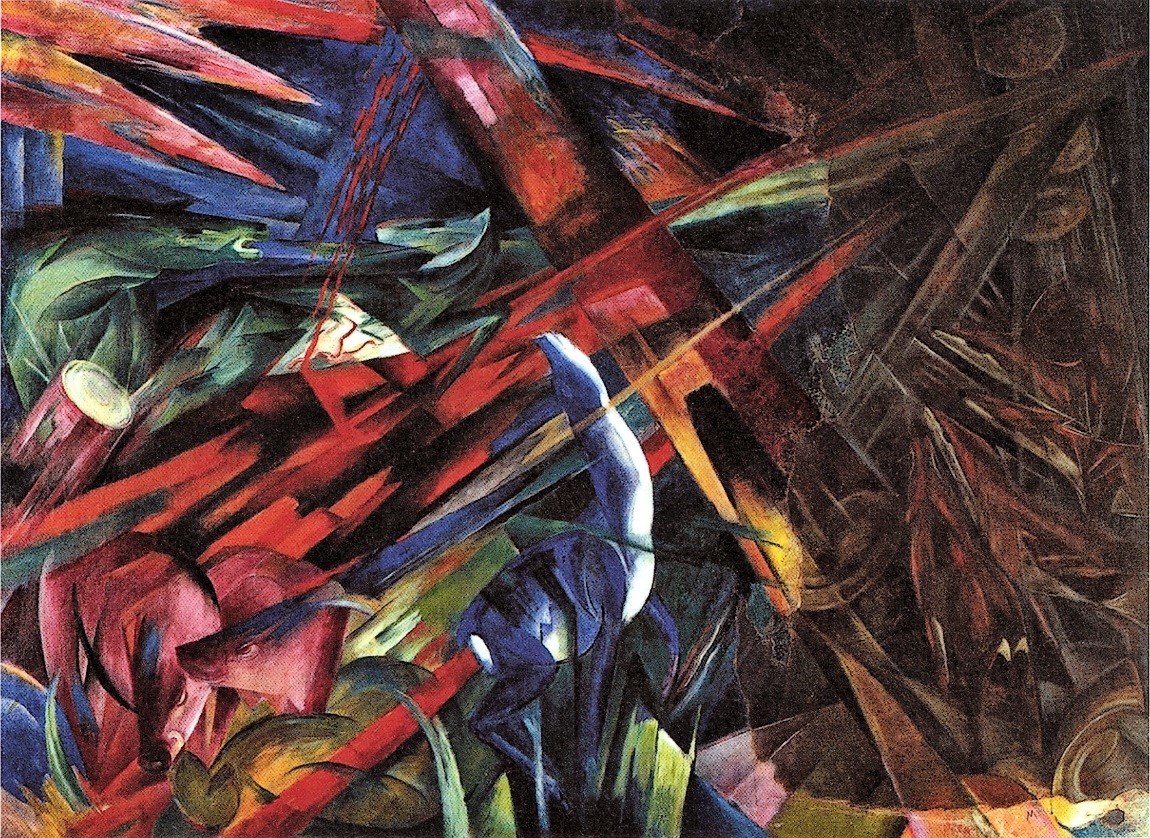
"Very early on I saw human beings as 'ugly'; animals seemed to me more purer, more beautiful, but even in them I found so much that was ugly and contrary to feeling that, following an inner compulsion, my pictures instinctively grew more schematic and abstract, until I suddenly became aware of the ugliness, the impurity of nature."
— Franz Marc, in a letter to his wife Maria, 1915 Left: The Fate of the Animals, Franz Marc, 1913
I’d wager the following statement is generally uncontroversial: suffering is bad, even if the sufferer is non-human. Even the most fervent steak-enthusiast will tell you that she would much rather a cow live a happy life rather than die miserably being crushed under a tree. We see this propensity to care about animal suffering everywhere in society — think of how easily perpetrators of animal abuse garner ill-will and hatred.1
In parallel, I want to illuminate another worldview that lurks in the human spirit: the propensity to romanticize nature. Who among us hasn’t been moved by the sheer beauty we see when we journey into the mountains, the woods, or the beaches? Many of my favorite artworks are landscape paintings, and indeed the fame of landscape painters and movements like the Hudson River School are further evidence of this kind of romanticization of nature. And it makes complete sense that we should find such things beautiful — we evolved out of these very environments and lived among them for millennia. There even seems to be empirical evidence that being in nature is good for you, if any of my fellow Computer Science/Engineering majors had any doubt.
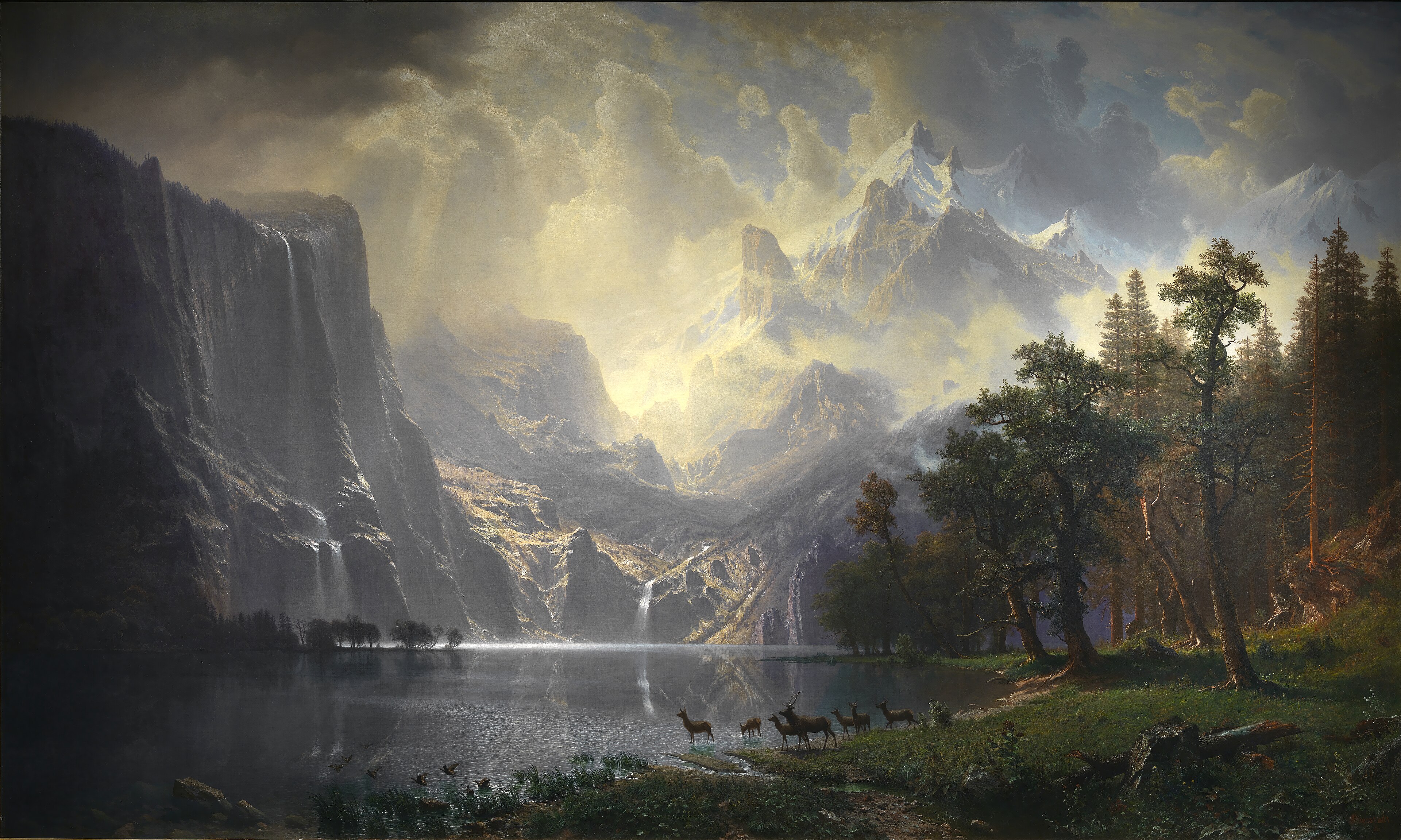
What I find particularly fascinating about these two tendencies — aversion to suffering and attraction to nature — is that they seem to be deeply embedded in most people, and yet they exist in complete conflict with one another!
The key point is not merely that suffering abounds in nature, but rather that suffering is embedded in nature at its very core. Alex O’Connor has a line he often delivers as part of his “Argument from Animal Suffering” which I’ve taken a liking to: “suffering is the very engine of evolution”. His point being, of course, that the very mechanism by which living beings propagate is driven by suffering. The modern gazelle is only able to run so fast because millions of its slower predecessors were violently killed by cheetahs.
But if this relationship of suffering to evolution feels unconcerning, perhaps due to the abstract character of “evolution” as a process or scientific principle, fret not: I think Alex’s principle can be extended from evolution to the natural world more concretely. The steady state of so many natural systems can only be maintained through a myriad of processes steeped in suffering. To illustrate the point, it is worth considering a few examples:
- In any stable food chain, we expect predators to hunt and kill their prey, generation after generation. If the prey species is not condemned to a life of fear and the possibility of death at the hands of a predator, their population will balloon out of control, and wreak ecological havoc.
- Forest fires are natural processes that are healthy, in the long term, for the forest. To maintain long term ecological balance, fires must periodically devastate parts of a forest and upend the lives of animals there.
- If one is to believe r/K selection theory, one should also take into account the misery abundant in the life of an r-selector. The fruit fly that lays 500 eggs should expect most of its offspring to die within days of being born, whether from predation, starvation, or other environmental conditions.
These are not instances of suffering that happen, incidentally, to be a part of nature. The routine occurrence of these phenomena are prerequisites for the existence of nature as we know it.
There is an aesthetic point to be made here: if suffering is so deeply embedded in nature that it is often far-fetched to divorce the two, musn’t this recontextualize the way we experience beauty in nature? With this knowledge I can no longer stand atop a mountain and gaze at the beauty of the forest below without realizing its inhabitants must one day burn for its continued existence. But alas aesthetics does not operate within the domain of logic; no amount of contemplation on suffering could entirely change the visceral reaction I have to its beauty, nor do I particularly want it to.
So perhaps the more salient point to be made here is the ethical one. What amounts to the romanticization of nature in the aesthetic domain is paralleled by our deification of the natural order in the ethical domain. That is to say, we instinctively enshrine the natural order — the natural processes by which humans are (largely) unaffected — as a good in and of itself. At the very least, most people view a natural state of affairs as an acceptable one. And the acceptance or rejection of this doctrine has significant consequences for our moral worldview.
Following certain conventions in other disciplines of philosophy, and because I think it sounds satisfactorily pretentious, I want to distinguish between “easy” and “hard” problems in animal ethics. An example of an easy problem is that of meat eating and factory farming; I have not heard a good argument for the continued existence of either, and quite frankly I doubt they exist. This is partly an easy problem because, in addition to the suffering being so gratuitous, it is notably artificial. Even many of those who support meat-eating in light of it being “natural” are appalled by the horrors of factory farming (given that they care about animals in the slightest). This is precisely because factory farming is an artificial abomination, engineered by humans to cause billions of sentient beings to suffer artificially.
So what are we to do about natural, rather than artificial, abominations? This is precisely what makes many “hard” problems of animal ethics much more difficult to grapple with than the “easy” problems. Let’s consider one such hard problem: the existence of predation. When there’s no doubt that predators collectively induce unfathomable levels of suffering upon their prey, why does it feel so counterintuitive to want to do something about this? Even if predators are not moral agents, why does it feel almost ridiculous to want to take action to eliminate predation? Why is this feeling so widespread?
Every so often I see a tweet pop up on my Twitter feed from a vegan denouncing predation as a scourge to be eradicated. Such posts are reliably met with mockery and scorn.
— @travistalks, in his excellent Substack article The Moral Status of Predation
You might think that the ridicule levelled at this position is one of practicality. How are we supposed to eliminate predation? Do we kill all the predators? Doesn’t that introduce more suffering??? Even if we desired such an outcome, how would we even manage to achieve it?????
Unfortunately, I don’t think this is the true cause of all the ridicule. People seem just as repulsed by the idea of eliminating predation even if we talk in purely hypothetical terms. Imagine a world in which humans have attained supreme scientific control of the environment, and wield the full force of genetic power. We could painlessly sterilize all predators to cause them to die out over time, and genetically modify prey species to reproduce at lower rates to maintain ecological balance. More generally, in this world, humans have also accounted for any ecological side-effects such an action could have.
I introduced the aforementioned thought experiment to my friends recently, and polled them on their support for such an action on a scale from 1-10 (1 = “I really hate this proposal and would actively lobby against it”, 10 = “I really love this proposal and would actively lobby in favor of it”). While there were indeed a wide range of responses, the most common answer was a 2! Here we have a group of people who all generally care about animals and think suffering is severely bad, but reject a proposal to massively reduce animal suffering!
And even though I disagree with them, I completely understand where they’re coming from: there is something about this bastardization of nature that feels deeply troubling. Ecological balance has, for millions of years, been contingent on suffering; thus, our hatred for suffering has come into direct conflict with our solidarity with the natural world. And, for many people, the latter quietly wins the battle.
Some of you may still think it silly to devote so much time to a question that, for all intents and purposes, can have no worldly impact today. Let us consider, then, another hard problem in animal ethics: the construction of vivariums. Here, I am not talking about vivariums used for scientific research or vivariums that house an animal which lives a life of peace and stability. Rather, I’m talking specifically about a hobbyist’s construction of a vivarium that is designed to simulate as precisely as possible the conditions of the natural world. And this isn’t a particularly uncommon occurrence either: there is a thriving community of vivarium enthusiasts active on platforms like YouTube. Popular vivarium YouTuber AntsCanada regularly uploads videos to millions of views, on his channel with nearly 7 million subscribers!
In these vivarium/terrarium/aquarium construction and maintenance videos, we often see the creation of an artificial ecosystem, complete with predators and all. The aquarium builder may source a fish species from a breeder, add them to a tank, and allow them to breed undisturbed. When the population gets out of hand, as expected, the builder introduces a predator species to maintain equilibrium in the tank. And not once have I seen this identified as unethical!2 In what meaningful sense is this different from allowing your pet rabbits to breed uncontrollably, and unleashing a wolf in their habitat to stabilise the population?! As an even more ludicrous example, would we be okay with a hyper-advanced alien civilization kidnapping a human from the 21st century, and dropping him into a recreation of the stone age, complete with predators, disease, and natural disasters??
I suspect the suffering that is added to the tank is not identified as problematic precisely because it feels natural; to recreate the natural order is not a sin. Our inner battle of ideals has a clear victor: our affinity for the natural again silently triumphs over our hatred for suffering. In fact, I suspect many of you whose intuitions accord with these are not swayed by the rabbit-wolf example, and are only challenged by the human-stone age example because we’ve come to view humans as existing outside of the natural order.3
What I find particularly troubling about these “hard problems” are the little consideration they receive, in both societal and personal contexts. We are so undisturbed by the existence of suffering in a natural context that nobody pauses to think before introducing predators to their tank. When the appeal to nature fallacy is so commonly identified as problematic in a human context, why is it so easily glossed over in a non-human one? Though I clearly have my views on nature’s relationship to goodness, I am less concerned with the particular views most people adopt on the matter, and far more worried about the fact that the issue altogether evades our attention when we’re not talking about human problems!
I have little else to say on the relationship between nature and suffering except to lament their tragic relationship to human intuition. Evolution is a devious thing which has imparted two conflicting instincts in our heads, for evolution cares little about moral consistency. A subtly insidious moral nature may well be a winning strategy in the game of survival. Coming to realise, over these past few weeks, that such an insidious nature dwells also within myself has been disconcerting, to say the least. Much of this post was about coming to terms with my own thoughts and intuitions, and understanding the importance of taking them seriously in a moral context. If nothing else, I hope it helps you do the same.
-
There is, of course, a much wider discussion to be had about attitudes toward animal suffering. There is considerable nuance to the claim being made here, and I hope to go into that someday, but for this article we may be content to accept axiomatically that people are ill-disposed to animal suffering. ↩
-
There are certainly ways of constructing a vivarium that I do not find morally disturbing; for instance, if the animals are sourced from the wild and not from a breeder, vivarium construction becomes a morally neutral act. Ultimately, the question of the morality of vivarium building is another subject that deserves far more extensive discussion than I can afford here. Suffice it to say that I am troubled by the way in which many people go about vivarium construction; I would encourage you to think about the matter further on your own. ↩
-
This is precisely why I identified the natural order as “the natural processes by which humans are (largely) unaffected”. ↩